


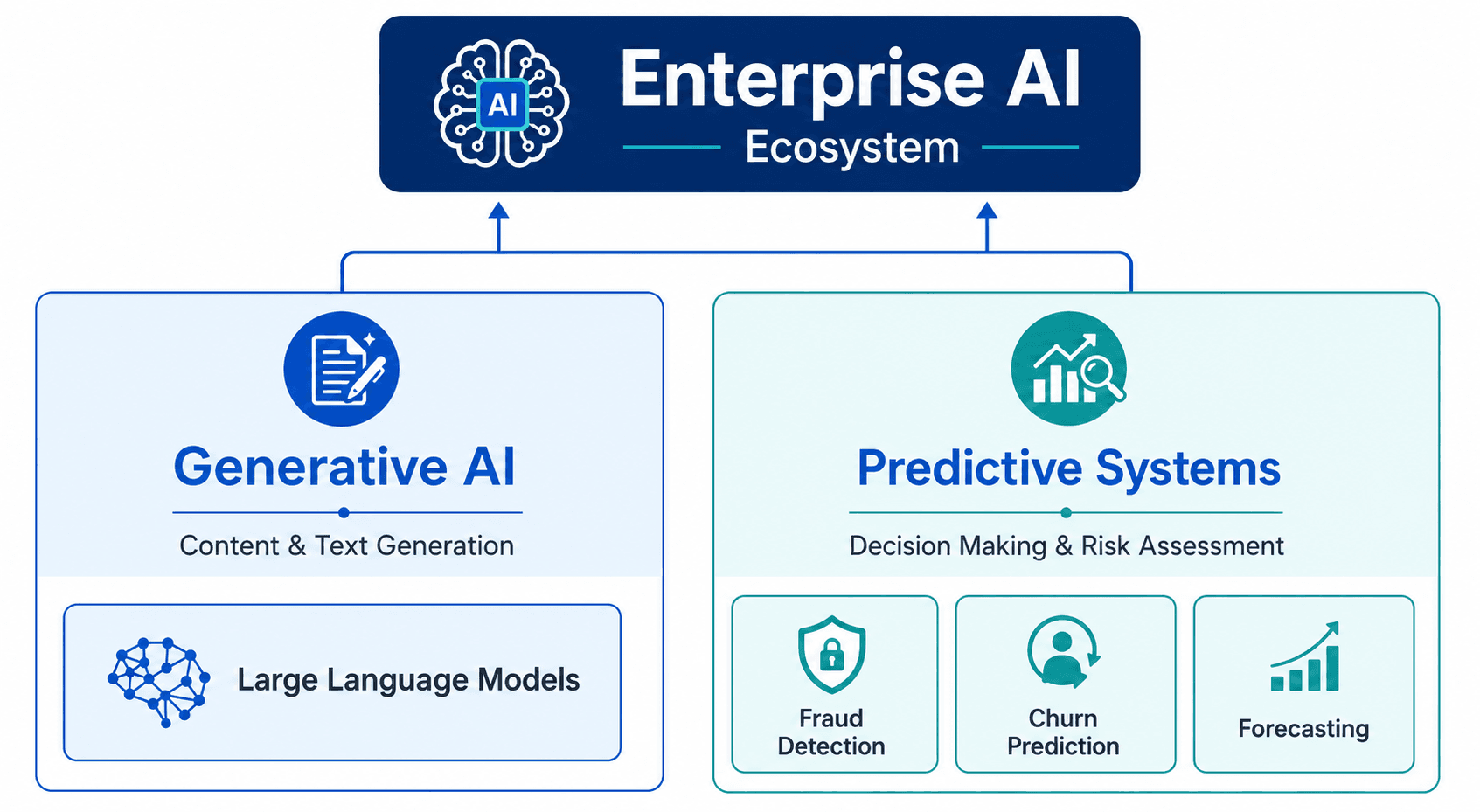
Over the last few years, artificial intelligence has become almost synonymous with large language models, chatbots, and content generation. While these technologies have transformed how organizations interact with information, they represent only a fraction of the value AI delivers today.
Behind the scenes, neural networks continue to power many of the systems that directly affect business performance. Every day, organizations use them to detect fraud, forecast demand, predict equipment failures, personalize customer experiences, and identify customers at risk of leaving.
In most enterprise environments, AI is not about generating content. It is about improving decisions.
What is a neural network?#
At its core, a neural network is a mathematical model that learns relationships between inputs and outputs from historical data. Instead of relying on manually defined rules, neural networks identify patterns automatically and use those patterns to make predictions.
These predictions can include:
- Fraud probability
- Customer churn risk
- Product recommendations
- Demand forecasts
- Equipment failure likelihood
Their strength lies in their ability to model complex relationships between multiple variables simultaneously, making them particularly effective for real-world business problems.
Where neural networks create business value#
Financial services#
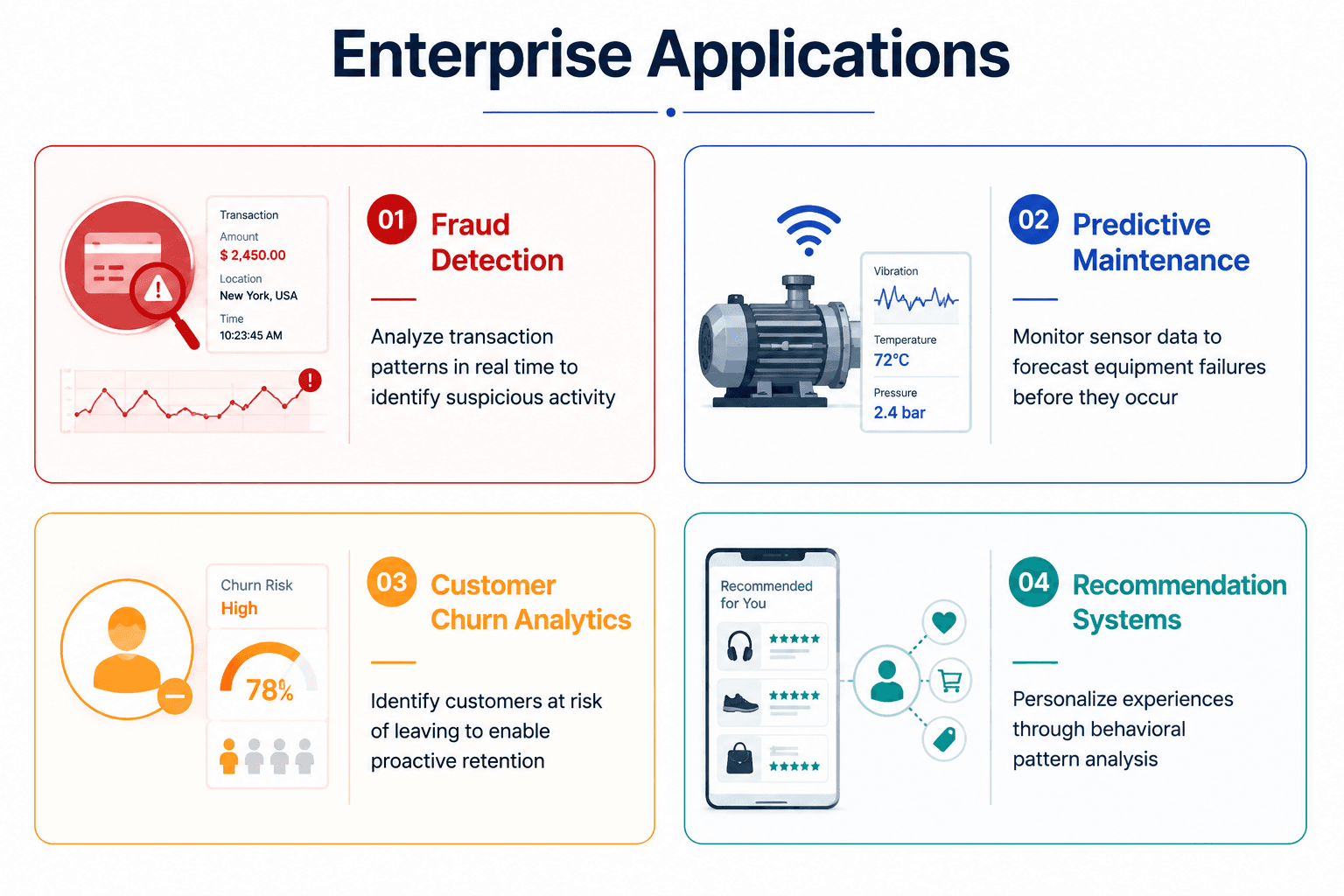
Financial institutions use neural networks to detect fraudulent transactions and assess financial risk in real time. By analyzing transaction history, location, spending behavior, and other variables, these systems can identify suspicious activity more effectively than traditional rule-based approaches.
Business impact:
- Reduced fraud losses
- Faster transaction processing
- Improved customer experience
Manufacturing#
Industrial equipment continuously generates sensor data related to temperature, vibration, pressure, and energy consumption. Neural networks can analyze this information to predict failures before they occur.
Business impact:
- Reduced downtime
- Lower maintenance costs
- Improved operational efficiency
Retail and e-commerce#
Recommendation systems use neural networks to personalize customer experiences by analyzing purchase history and behavioral patterns.
Business impact:
- Higher conversion rates
- Increased customer retention
- Greater customer lifetime value
Telecommunications#
Customer churn prediction models help organizations identify subscribers at risk of leaving. This allows businesses to intervene proactively with retention strategies.
Business impact:
- Reduced churn
- Increased recurring revenue
- Improved marketing effectiveness
Why MLPs still matter#
When discussing AI today, most conversations focus on transformers and large language models. However, the majority of enterprise data remains structured:
- Customer records
- Financial transactions
- CRM data
- Sensor readings
- Inventory systems
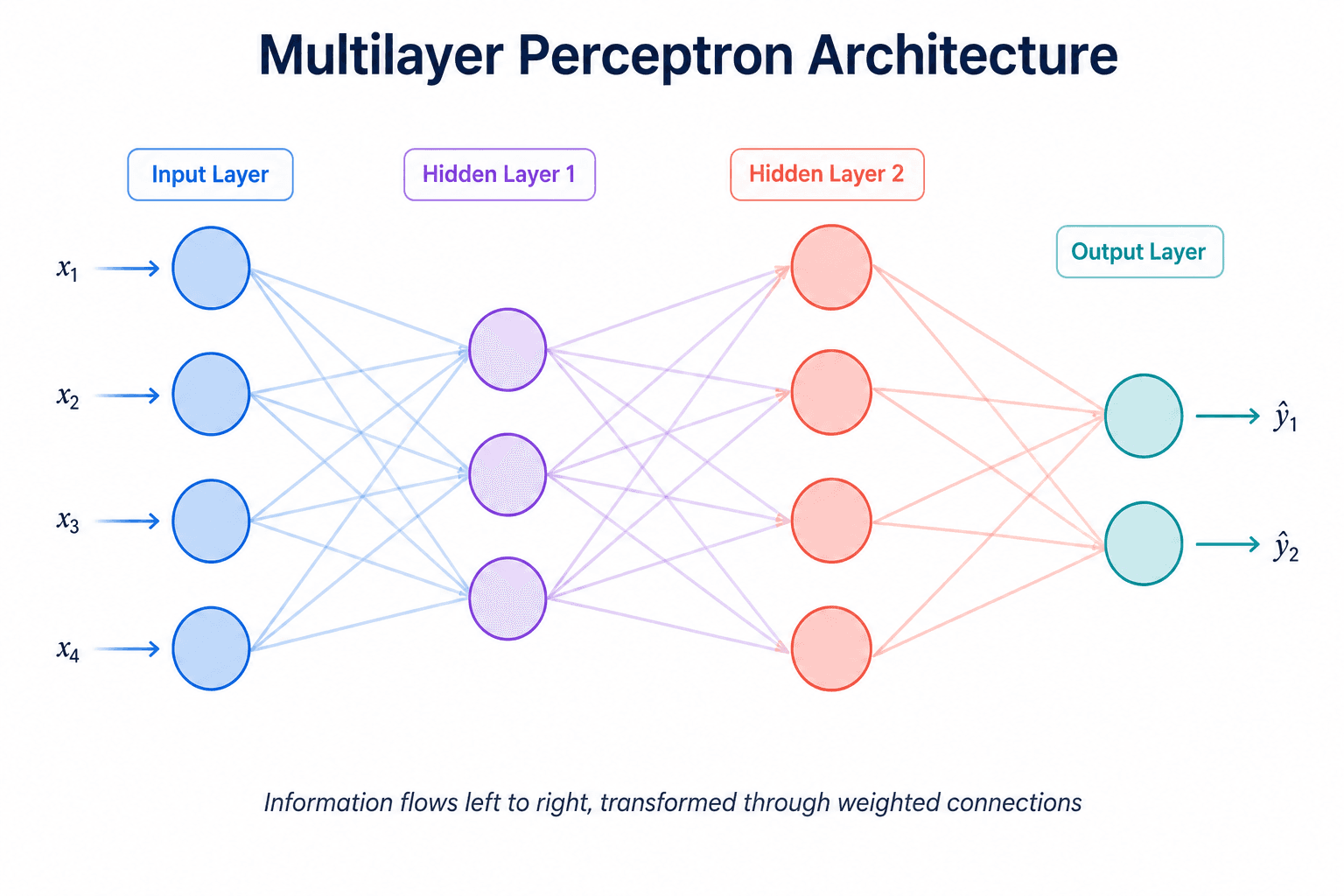
For many of these use cases, simpler architectures such as multilayer perceptrons remain highly effective. They are easier to train, require fewer computational resources, and often deliver excellent performance on tabular business data.
Not every problem requires a billion-parameter model. Many enterprise challenges can be solved with a well-designed neural network trained on high-quality data.
The real challenge is not the model#
Organizations frequently underestimate the complexity of operationalizing machine learning. Model development is only one component of a successful AI initiative.
A typical enterprise workflow includes:
- Business problem definition
- Data collection
- Data engineering
- Feature engineering
- Model development
- Deployment
- Monitoring
- Business adoption and continuous improvement
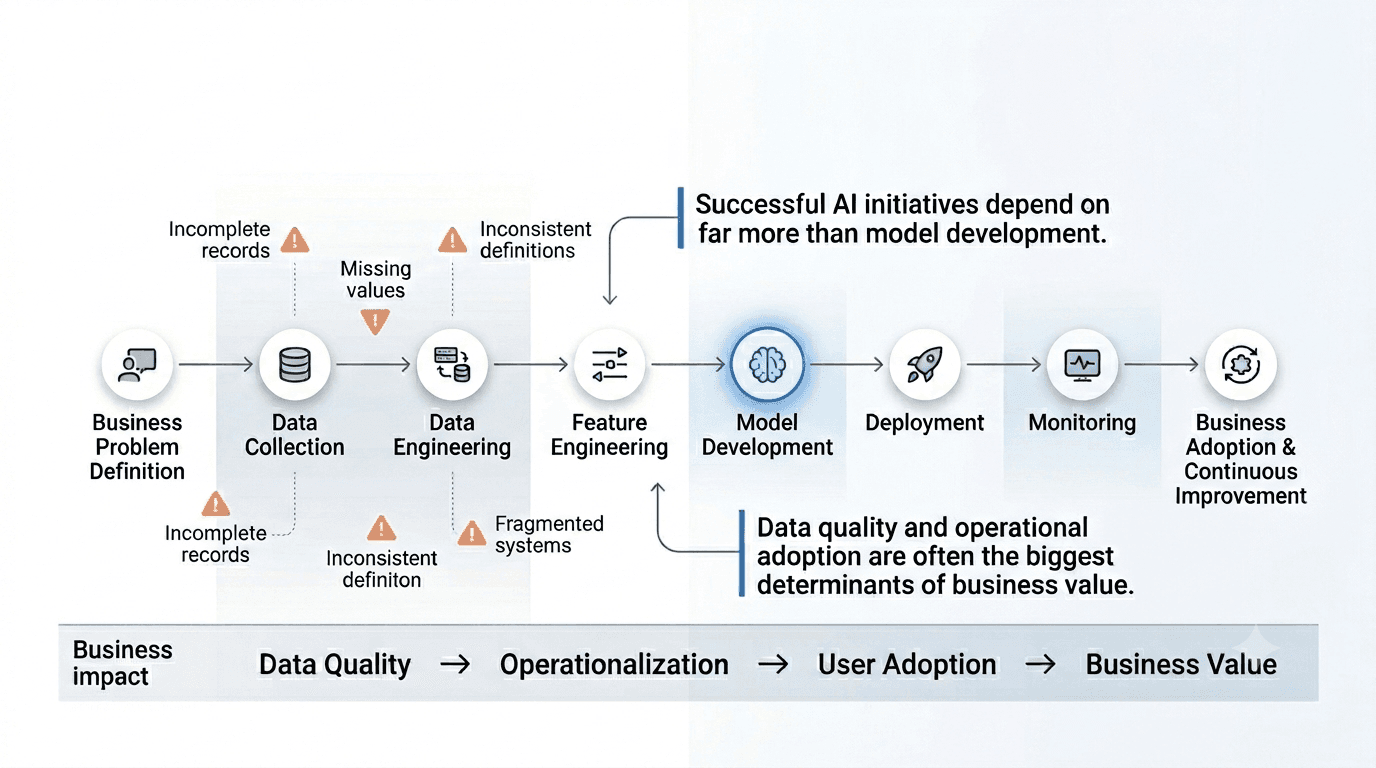
In many cases, data quality becomes a greater challenge than model design. Incomplete records, inconsistent definitions, missing values, and fragmented systems often represent the largest obstacles to success. Organizations that focus exclusively on model selection while neglecting data governance rarely achieve sustainable results.
Successful AI programs recognize that machine learning is not simply a technology initiative. It is an organizational capability.
Conclusion#
Despite the attention surrounding generative AI, neural networks remain one of the most important technologies powering enterprise AI solutions. From fraud detection and predictive maintenance to recommendation systems and customer retention, they help organizations transform data into better decisions.
The value of neural networks does not come from their complexity. It comes from their ability to solve real business problems.
In our next article, we will move from theory to practice by building a multilayer perceptron from scratch and applying it to real-world datasets to explore how these models can generate measurable business impact.
References#
- Rosenblatt, F. (1958). The perceptron: A probabilistic model for information storage and organization in the brain.
- Rumelhart, D. E., Hinton, G. E., & Williams, R. J. (1986). Learning representations by back-propagating errors.
- Hornik, K., Stinchcombe, M., & White, H. (1989). Multilayer feedforward networks are universal approximators.
- Goodfellow, I., Bengio, Y., & Courville, A. (2016). Deep Learning.