

A few months ago I ran into a curious paradox. Today's language models can explain complex concepts, write code, and even help solve technical problems with surprising precision. But if you ask them about an internal company document, a private manual, or a specific protocol, they know nothing.
That makes sense: this knowledge was not part of their training. I thought about something common in any organization: a company accumulates hundreds of documents.
- Procedures
- Contracts
- Protocols
- Reports
- Regulations
- Internal manuals
All that information exists, but getting to it quickly is usually hard. I asked myself a question:
What if we could talk to those documents the way we talk to a person?
Not by searching keywords. Not by browsing folders. Just by asking: "What is the procedure for X?" and getting a clear answer grounded in internal documentation. That is where the project started.
What a RAG system really is#
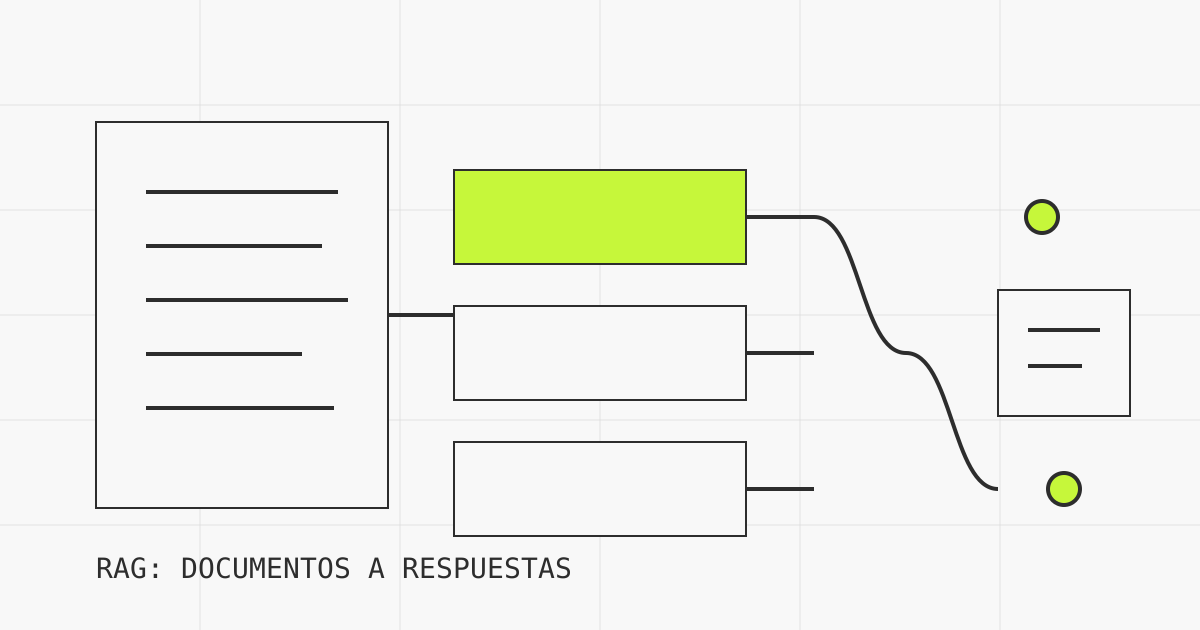
The simplest way to understand a RAG system is to imagine a library.
A traditional language model is like a very smart person who answers only from memory. Sometimes it is right, sometimes it is not, and it cannot access private or company-specific information. A RAG system works differently.
Before answering, it searches for relevant information in a document collection. It retrieves the most useful passages and gives them to the model so it can generate the answer.
In other words: it does not answer only from memory. It answers with evidence. That completely changes its usefulness in business environments.
How I built the system#
The goal was clear: let a user upload PDF documents and ask questions about them in natural language.
The system flow was:
- Extracting PDF content
- Splitting text into chunks
- Generating embeddings for each chunk
- Storing them in a vector database
- Running semantic search over relevant chunks
- Sending the retrieved context to the language model
- Generating an answer with source references
PDF documents
  |
  v
Extraction and cleanup
  |
  v
Chunking
  |
  v
Embeddings
  |
  v
Vector database
  |
  v
Semantic search
  |
  v
LLM + retrieved context
  |
  v
Answer with cited sources
A practical example#
Imagine a company has several internal documents:
- Procedure manual
- Returns policy
- Internal regulations
A user can ask:
How many days in advance do we need to request a return?
The system searches the documents for relevant information and answers:
The important part is not only the answer, but traceability: being able to verify where the information came from.
What I learned during development#
Before building it, I thought a RAG system was mostly about connecting tools. In practice, I learned that the real work is in design decisions:
- Chunk size directly affects answer quality.
- Chunks that are too small lose context.
- Chunks that are too large introduce noise.
- The amount of retrieved information changes model precision.
The quality of the system does not depend only on the model, but on how knowledge is structured and retrieved.
A personal reflection#
During my training as a psychologist, I learned something that feels relevant here: much of human intelligence is not only about storing information, but about retrieving it at the right moment.
Something similar happens in organizations. The knowledge already exists. The challenge is making it accessible. That is where I think systems like RAG start to matter: they do not replace knowledge, they make it usable.
Conclusion#
Artificial intelligence is not only a tool for generating text. It can also become an interface for an organization's knowledge.
The biggest change may not be technological, but conceptual: we move from searching for information to having a conversation with it.